

C.R.A.F.T. Frontline Tastings: Creating the Room for Connections

Veteran entrepreneurs, industry barriers and a community creating space for opportunity
Sept.29,2026
TAMPA, FL - Inside C.R.A.F.T. Frontline Tastings, the products were front and center. The energy in the room was high as founders poured samples, introduced their brands and talked with guests moving from table to table. Products lined the displays; conversations filled the room and each table offered something different to discover.
What wasn't as easy to see were the challenges it had taken to get those products there.
C.R.A.F.T. is an organization built around veterans, first responders and supporters working throughout the beverage and hospitality industry. Through education, advocacy, industry relationships and events such as Frontline Tastings, it is creating a place for people building careers and businesses in an industry where regulation, manufacturing, distribution, competition and access can make getting established especially difficult.
This past week, Frontline Tastings brought some of those business owners together in Tampa. Their businesses included spirits, nonalcoholic beverages and other products connected to the beverage and hospitality industry.
I came to learn about their brands. The more people I spoke with, the more interested I became in what it had taken to build them.
Behind the finished products were stories about manufacturing, inventory, distribution, restaurant accounts, reorders and competition. One challenge came up in different ways throughout my conversations: getting a brand in front of someone willing to give it a chance.

What makes this event so special is that many of these brand founders had spent years, even decades, serving their country. Some were drawing on the discipline, leadership and problem-solving skills shaped during their military careers as they built their businesses. Others were learning how to navigate an entirely new industry, with its own rules, relationships and way of doing things. In different ways, they were pursuing their own piece of the American Dream and figuring out what came next after service.
Their military service hadn't given them a shortcut into the industry. The product still had to get made. The distributor still had to take the call. The buyer still had to make room. The bartender still had to learn the name. The consumer still had to choose it.
They weren't asking for the business to be handed to them. They were trying to earn the opportunity to compete for it.
Eric Dominijanni was one of the founders I met at Frontline Tastings. A retired Marine major who served 20 years in the Marine Corps, Dominijanni is the founder and CEO of FIOR Scotch, which has been recognized as the first Black-owned Scotch brand and the first U.S. veteran-owned Scotch brand.
FIOR grew from a Scotch blend Dominijanni had originally created for himself. What began as a personal blend eventually became a business and made its way to market.
“What good is a chef who can't serve his meals? What good is a singer who doesn't have an audience? What good is a dancer who doesn't have a partner?” Dominijanni said.
FIOR had made it to market, but his point was about what comes next. A product can be available and still be competing for visibility, distribution and consumer attention against established names that are already nationally distributed and advertised.

Navy veteran Joshua Perschbacher had launched Harrison Justice Whiskey Co. only days before we spoke. The company takes its name from his great-grandfather, Harrison Justice, an Army veteran of World War I.
Perschbacher was balancing the company with a full-time career, something he described as both a “blessing and a curse.” When we talked about growth, he wasn't focused on getting into as many accounts as possible as quickly as possible. He was thinking about what would happen after he landed one.
One word kept coming up in our conversation: reorder.
Getting a restaurant to bring in the first case is an accomplishment for a new brand. If that case sells and the restaurant wants another, the company has to be ready to supply it. For Perschbacher, growth wasn't simply about opening doors. It was about making sure the business was prepared when that door opened.

Brandon McCraney, founder of Olde Raleigh Distillery, talked about another reality of building a brand: being able to explain it quickly enough to get someone's attention.
“You gotta keep it simple. You got to keep it tight. You gotta give the 15-second, 30-second, 60-second, 90-second conversation, depending on who you're talking to,” McCraney said.
Behind a busy bar, that 15-second version can be especially relevant. There isn't always time to explain the founder, the company, the production process and everything that separates one product from the bottle sitting beside it. Sometimes a bartender has only a few seconds to give a guest a reason to try something they've never heard of.

The challenges facing independent brands aren't limited to spirits. David Marsceau, representing Wild Bill's Craft Beverage Co., spoke about what those challenges can look like in the craft soda business.
Wild Bill's is a veteran-owned and veteran-led company. CEO Mike Quilty is a former U.S. Navy officer who served aboard the submarine USS Gato. The company has also made creating employment and business ownership opportunities for veterans part of its mission, including through its veteran franchise program.
Marsceau talked about the company's move from its event-based roots into packaged retail and the challenge of competing for restaurant business in a category dominated by major beverage companies with national distribution, established accounts and advertising budgets independent brands simply don't have.
Wild Bill's wasn't selling whiskey or Scotch, but some of the challenges and obstacles were the same. How do you get in front of the right person? How do you convince an account to make room for something unfamiliar? And once you get the opportunity, how do you turn it into repeat business?

Creating opportunities for those connections is part of the work behind C.R.A.F.T. Dolly Gray, the organization's director of community engagement, has helped develop C.R.A.F.T. alongside her husband, President and CEO Mike Waskewich. Both are retired veterans.
“We were raised with a sense of purpose and a sense of service,” Gray said.
Gray was careful about what C.R.A.F.T. represents. The organization isn't about encouraging veterans to drink. Its connection to the beverage and hospitality industry is much broader, extending across the businesses, careers and people that support it.
Carlie Wilson, C.R.A.F.T.'s director of partnerships and fundraising, also spoke about how difficult it can be for independent brands to break into the beverage industry, particularly without the financial resources and industry reach available to larger companies.
Her role focuses on developing partnerships that can create exposure, relationships and opportunities for businesses within the organization.
“There's no other group of people I'd rather help boost into that and make sure that they're out there and have the support they need,” Wilson said.
Wilson described the industry as much larger than the product that eventually reaches a shelf or back bar. Bringing a brand to market involves a network of businesses and people working throughout the process.

Jose Pila, an Army veteran and founder and CEO of Warrior Dog Spirit, spoke about a lesson from his military training that has stayed with him throughout his life and in business.
When we talked about what he had carried from the Army into business, Pila turned to land navigation and the military practice of “taking a knee.” If you lose your bearings, he explained, you stop and return to your last known point, determine where you are and establish the direction of your next rally point before moving again.
“I had to take a knee many times in my life,” Pila said.
It is a lesson he has carried into business as well. “That's helped me a lot in sales,” he said.
For Pila, however, selling Warrior Dog isn't simply about selling whiskey. He spoke about sharing the story behind the brand and the hope he wants it to represent for other veterans.
“You're not just selling a bottle of whiskey,” Pila said. “You're sharing a story.”

Creating the Room for Connections
At Frontline Tastings, I spent much of the evening with my camera, moving between tables and documenting the founders, their products and the conversations happening around them.
Among the people I met was Tyrone W. Hodges, founder of Double Time Sports Drink and a 22-year Army veteran. Hodges traced the idea for his hydration brand back to his military experience. He remembered road marches, green canteens and the hydration demands that came with training.
Years later, watching soldiers at Fort Lee running PT and ruck marching brought those experiences back to him. In the middle of the night, the idea for Double Time came to Hodges, its name inspired by a term familiar from his time in the Army.
Turning the idea into a product came with challenges of its own. Hodges talked about manufacturing difficulties and eventually having to find another manufacturer to work with.

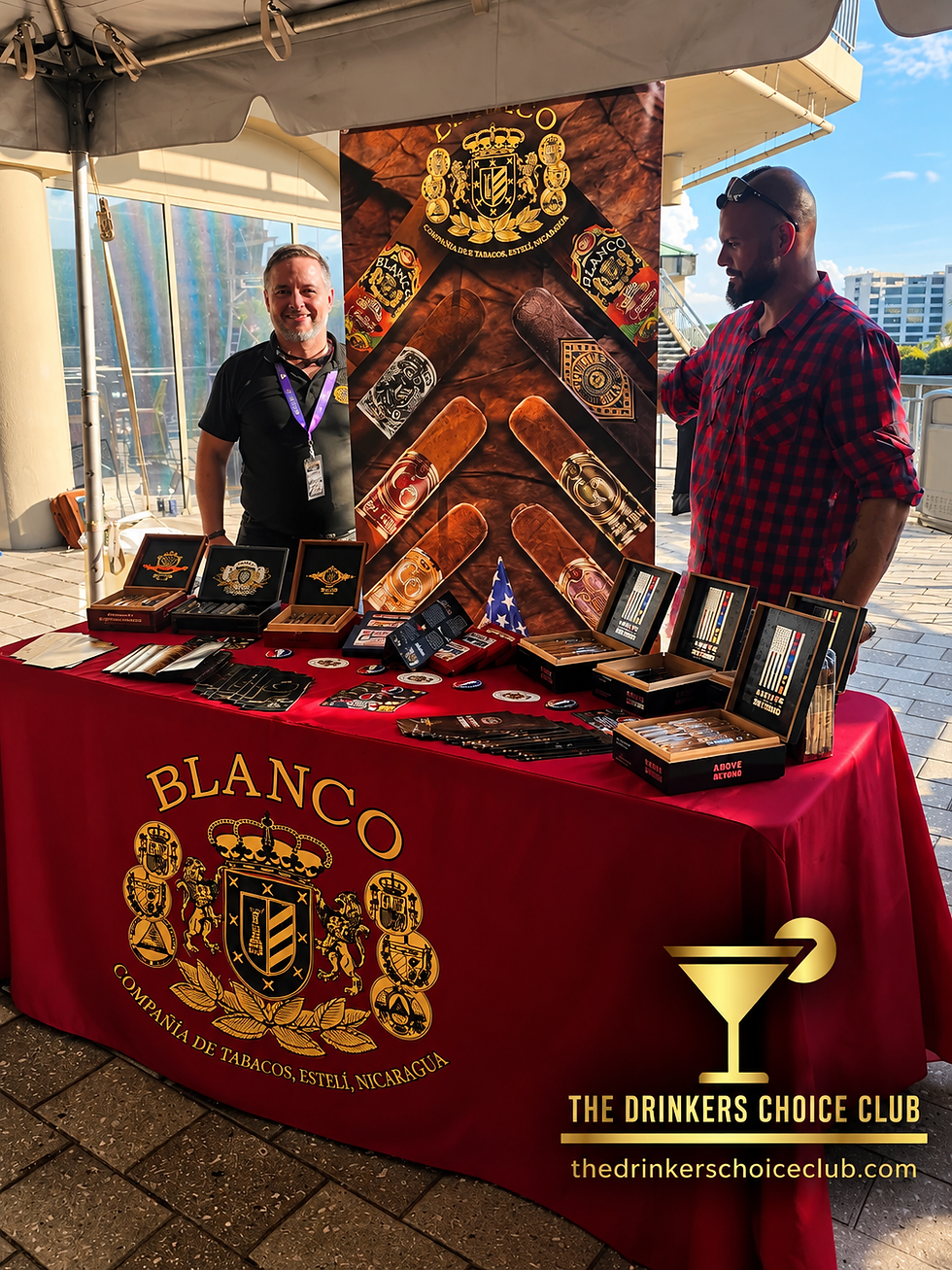
David A. Blanco, president of Blanco Cigar Company, represented another part of the hospitality industry.
Military service has long been part of the Blanco family story. David has served in the U.S. Army for more than 30 years in active-duty and reserve roles, including a deployment to Afghanistan in support of Operation Enduring Freedom. His father, Cesar A. Blanco, served more than 27 years in the Army and retired as a Chief Warrant Officer Four. At one point, father and son were deployed at the same time, David in Afghanistan while Cesar was serving in Iraq. David's uncle Francisco also served in the U.S. military. Blanco Cigar Company
Alongside that history of service is a family connection to tobacco that stretches back generations to Cuba's Pinar del Río region. After the family came to the United States, Cesar and Francisco eventually joined David in returning to those roots and establishing Blanco Cigar Company in the United States in 1998. Blanco Cigar Company
Blanco described premium cigars as a “companion product” to beverages, including Scotch, bourbon, whiskey, beer, wine and coffee.
The partnership with the Military Influencer Conference expanded that room even further, connecting participating businesses with a broader military-connected audience.
Throughout the evening, guests moved from table to table, meeting the people behind the products, while founders connected with one another, exchanged ideas and talked about possible collaborations. After spending much of the evening watching those connections happen, I sat down with C.R.A.F.T. President and CEO Mike Waskewich to talk about why creating a space like this was so important to him.
For Waskewich, Frontline Tastings wasn't simply about putting products on tables. It was about giving these brands a place to be seen, make connections and create opportunities that could continue after the event.
“We have to give them this room. We give them this room. I don't care what we have to do to make that happen, but we have to give them this room. Give them a space to allow them to actually do what they need to do,” Waskewich said.
Hearing Waskewich say, “give them this room,” was powerful because the meaning of those words was unfolding right in front of me.
Frontline Tastings provided a platform for these businesses to be seen, their stories to be heard and new relationships to begin.
Waskewich's vision for C.R.A.F.T., however, extends beyond Frontline Tastings. One of the places he wants the organization to grow is within established veteran organizations.
“I want us to start earning space in the large veteran organizations. The VFWs, the American Legions, the lodges, the clubs. All those,” Waskewich said. “I want to start earning spaces for these brands in those places.”
That could give veteran-owned brands another way to introduce their products to new audiences within communities already connected by military service.
A year from now, Waskewich hopes C.R.A.F.T. will have expanded those opportunities beyond what was happening here in Tampa: more places for brands to be introduced, more industry relationships and more ways to help open doors that can be difficult for independent businesses to reach on their own.

Frontline Tastings showed what one of those opportunities could look like.
For the veteran entrepreneurs I interviewed, military service didn't entitle them to shelf space, restaurant accounts or customers. They still had to make a good product, run a good business and work for every opportunity.
A great product deserves the opportunity to be recognized, but recognition starts with the opportunity to be seen. For these founders, that means getting their products in front of the buyers, bartenders, distributors, industry professionals and consumers who can decide for themselves what deserves a place on the shelf, behind the bar or in their glass.
There is still a long way between being seen in a Tampa convention room and building a successful brand. There will still be buyers who say no, distribution problems to solve, manufacturing setbacks, accounts that don't reorder and consumers who choose the familiar names they've seen advertised on shelves for years.
Interviewing the people at Frontline Tastings gave me a closer look at their businesses, the challenges they were facing and the stories behind what they had built.
I came to learn about their brands. I left with a greater appreciation for what these veterans are building and the opportunities that can come from bringing the right people together.
C.R.A.F.T. is creating a place where people can make connections, share what they've learned, collaborate when it makes sense and help others find their way into an industry that isn't easy to break into. As that community grows, so does the possibility that the people being helped today may be the ones opening a door for someone else tomorrow.
A year from now, I hope I'm writing about some of these same people, only this time about how far they've come.
And perhaps by then, we'll see where the next leg of the mission has taken C.R.A.F.T. and the community growing alongside it.

DCC Insider takes you behind the bottle and beyond the bar to meet the people, discover the brands and explore the stories, trends and experiences shaping the beverage and hospitality industry
Have a story, brand or industry event DCC should know about?
Contact The Drinkers Choice Club at thedrinkerschoiceclub@gmail.com


Comments